
Original price was: $175.00.$98.99Current price is: $98.99.
- Reliable Payments for Reliable Shopping
- Experience the Best Quality
- Multiple payment methods, 100% payment security
- Your Security is Our Promise

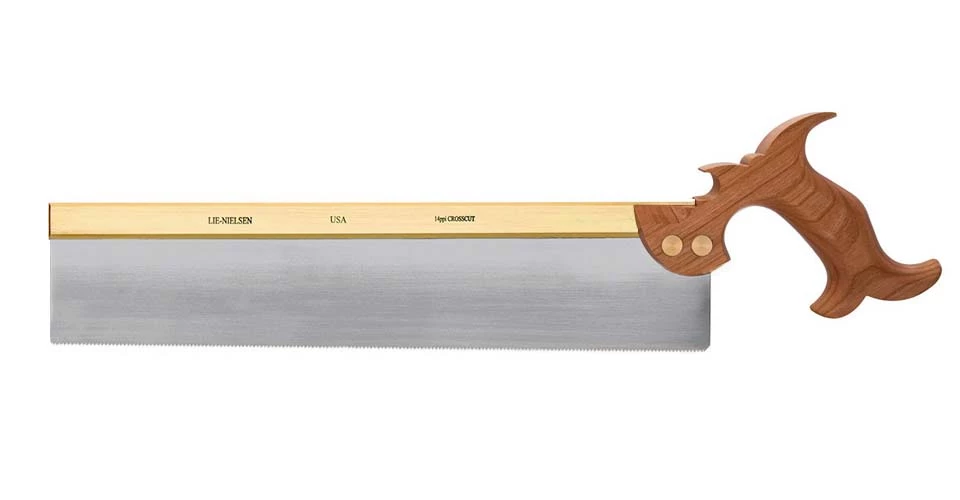
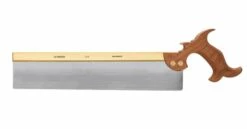
Tapered Carcass Saw with Cherry Handle
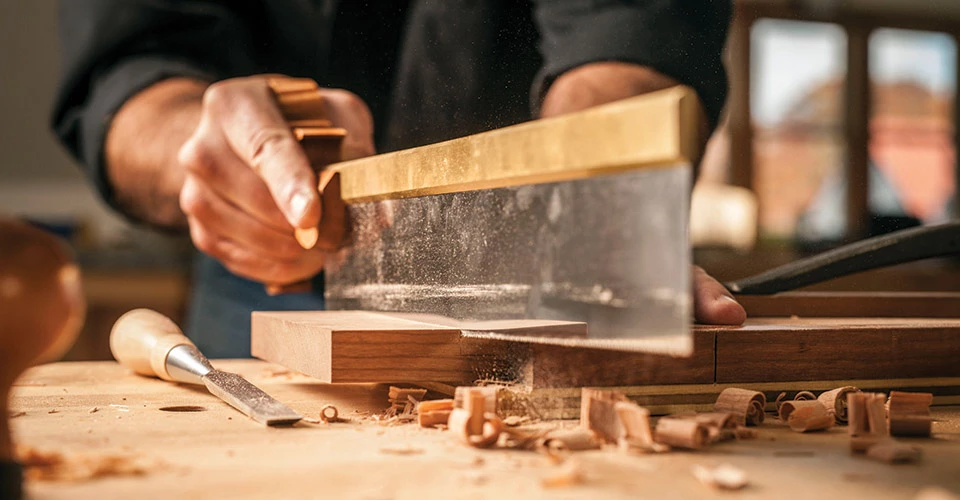
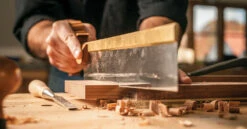
We’ve redesigned our three most popular back saws to feature a slight tapering of the blade from toe to heel. This taper gives you better control over precise cuts. When you reach the gauge line on the front of your stock, the blade is slightly above the line on the back side, which reduces the risk of sawing past your line. In addition, the taper introduces an angled approach to your stock (when holding the saw back parallel to the bench), enabling faster cuts with less effort.
Our Tapered Carcass Saw is patterned after our 14″ Carcass Saw with a thinner plate of .015″.
It tapers ¼” along the length of the blade, with a cutting depth of 2″ at the toe and 2-1/4″ at the heel. This combination of features yields a well-balanced saw that cuts extremely fast and precisely, with excellent surface finish.
- Teeth are filed crosscut, 14 ppi, set at .003″ per side.
- Overall length, including handle, is 19.”
- Overall height is 5.”
Read a review by Lost Art Press of The Advantages of Saws with Tapered Blades
Sharpening:
The steel in your saw’s blade is the best that’s available.
It is very hard (50-52R) and will stay sharp a long time. Eventually, however, you’ll have to sharpen it. You can do this easily yourself with a little
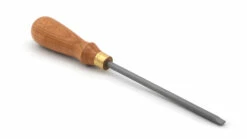
practice. We use a 6″ double extra slim taper file to file the teeth on our Tenon Saws. We use a 5″ double extra slim taper file to file the teeth on our Carcass and Dovetail Saws, and you can do the same if you’re skilled at filing. If not, start with a smaller 4″ extra slim taper file, which will make it easier to line up the file with the gullet for beginning filers.
Take a couple of pieces of thin, straight scrap and clamp them in your vise on
either side of the blade so that the top of the scrap is flush with the bottom
of the gullets on the teeth. Take your file and take one swipe per tooth. Notice
the small groove the file leaves in the wood. This is a good gauge to show you
how deep you’re filing. The teeth are so fine on your saw that no more than one
pass per gullet should be necessary. If you use this method consistently, you
shouldn’t ever have to joint your saw. Of course, Dovetail and Tenon Saw teeth are sharpened to a rip profile, so you can file all the teeth from the same side.
You can use a Stanley 42X saw set on our saws. The Stanley set may vary from
ours, so experiment on a small area before you do the whole saw. Your Carcass and Dovetail Saws only need approximately .003″ set per side, and Tenon Saws only .004″ per side when properly set. The slight set is what makes
the saw cut and track so well. If done improperly, you’ll notice a drastic
decrease in performance. You should only have to reset your blade after every
other sharpening, not every time.
The ultimate test of any setting job is how well the saw cuts. Take some scrap and start a cut. The saw should glide through the wood without jumping around in its kerf. It should not be hard to push, nor should it be roomy in the kerf. If either of these conditions exists, increase or decrease the set accordingly. If the saw tracks away from the line, the side on the saw that is furthest from the line has too much set. A simple remedy is to lightly stone the edge of the offending side with a medium India slip stone. Take one swipe with the stone, and try another cut. Usually only one or two passes with the stone will correct the problem. Don’t remove too much, however, or you will have the same problem on the other side until not enough set is left to make a cut. Once you have determined by trial and error that you have just enough set on that particular saw, make a note of where your saw set is adjusted for future reference.
Visit our YouTube channel for more tips on saw sharpening.
Materials:
We believe that our Back Saws are the finest made anywhere. Solid milled Brass back, best quality Swedish Steel blade, Maple handle and traditional Brass saw nuts and bolts.
Maintenance:
It is a good idea to keep a coat of oil or silicon spray on your saw’s blade when not in use. This will minimize the chance of rust
forming on the blade. The blade is high carbon steel with no rust-inhibiting alloys added. The handle on your saw is oiled and buffed with wax to produce a natural finish. Wipe with oil as desired to refresh.
Guarantee:
Materials and workmanship are guaranteed for the life of your
tool. Call for repairs or replacement parts. We are available for advice if you
ever have a problem using your tool.
Proposition 65 Notice: Bronze and brass alloys contain lead, a
chemical known to the State of California to cause cancer and birth defects, or
other reproductive harm. Wash hands after handling.
Be the first to review “Tapered Carcass Saw With Cherry Handle”
Related products
Reviews
There are no reviews yet.